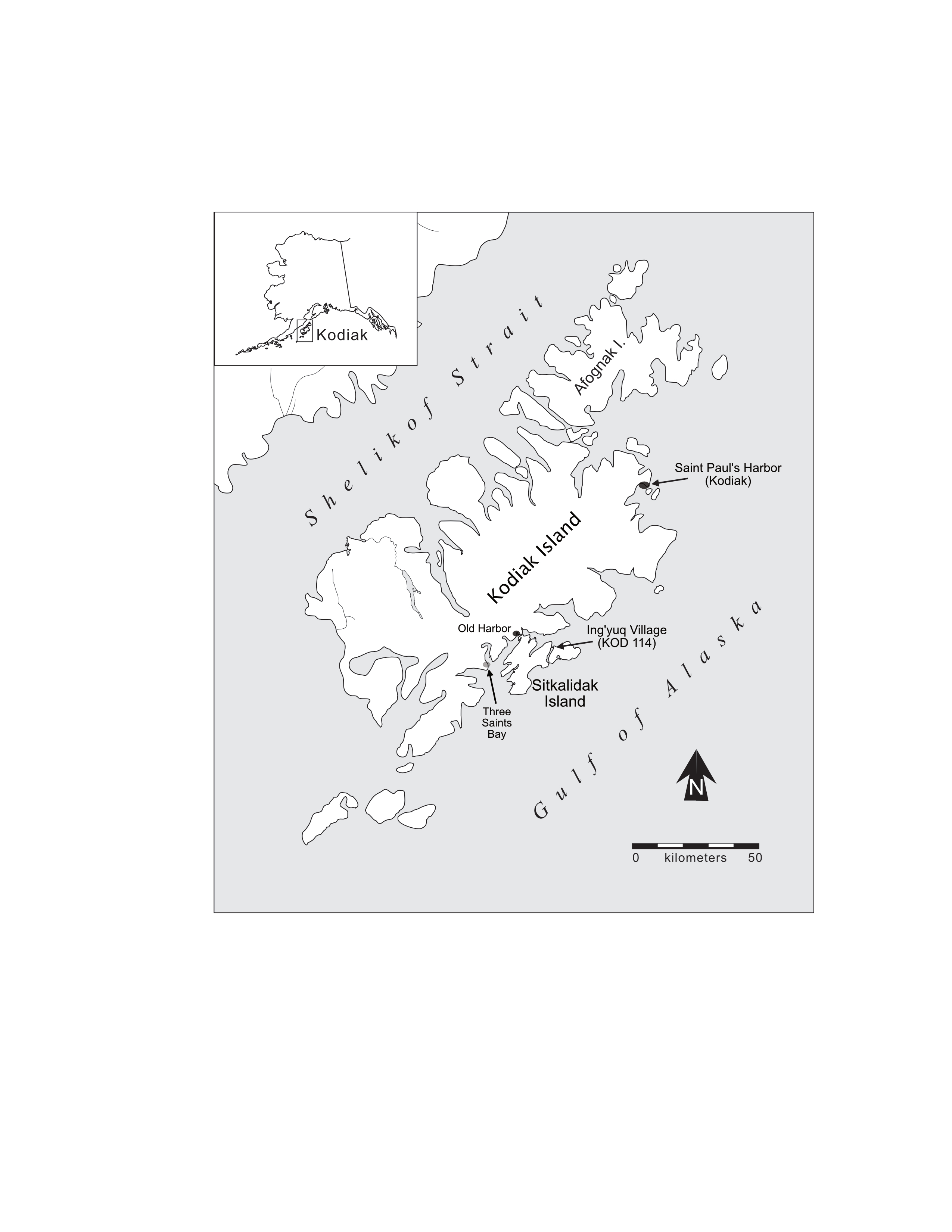
Native communities confronted Eurasian colonialism in ways that reflected their own unique histories, social organizations and cultural values. In this paper, we are interested in how such legacies shaped Indigenous survivance, the active presence of Indigenous peoples on the landscape or the refusal to disappear or assimilate into settler society. We seek to understand the climate changes that Native Alaskan Sugpiaq people faced during the Little Ice Age (LIA; ca. CE 1400–1850), how they responded to those changes prior to Russian incursion, and how new or renewed climate adaptations shaped Sugpiaq survivance. Drawing insight from a new multi-proxy analysis of climate change, ecological dynamics, human population history, archaeology, and ethnohistory of the Kodiak Archipelago, we argue that changes in climate variance during the LIA contributed to Sugpiaq cultural elaboration in the centuries prior to Russian colonialism. Persistent cultural values and relationships with marine resources, adaptations of those relationships under expanded levels of harvesting, and responses to evolving opportunities and political realities were key legacies carried into colonial circumstances by Sugpiaq people. In addition, we see the foundational role of Sugpiaq women in procuring and sharing subsistence foods and the development of regional Indigenous identities as important factors in Sugpiaq survivance in the Russian colonial period. While colonialism introduced novel threats, Sugpiaq people confronted those challenges with the tools and values they inherited from their past, and they persisted through the active deployment of creative and culturally appropriate responses to the co-crises of colonialism and climate unpredictability.
The Little Ice Age and Colonialism.
Miller, Hollis & Ben Fitzhugh, 2025. “The Little Ice Age and Colonialism: An Analysis of Co-Crises for Coastal Alaska Native Communities in the 18th and 19th Centuries.” Submitted to special issue on “The Archaeology of Climate Change” for the journal Heritage. Guest Editors: Sharon R. Steadman and John F. Haldon. Heritage, 8(12): 499. https://doi.org/10.3390/heritage8120499.