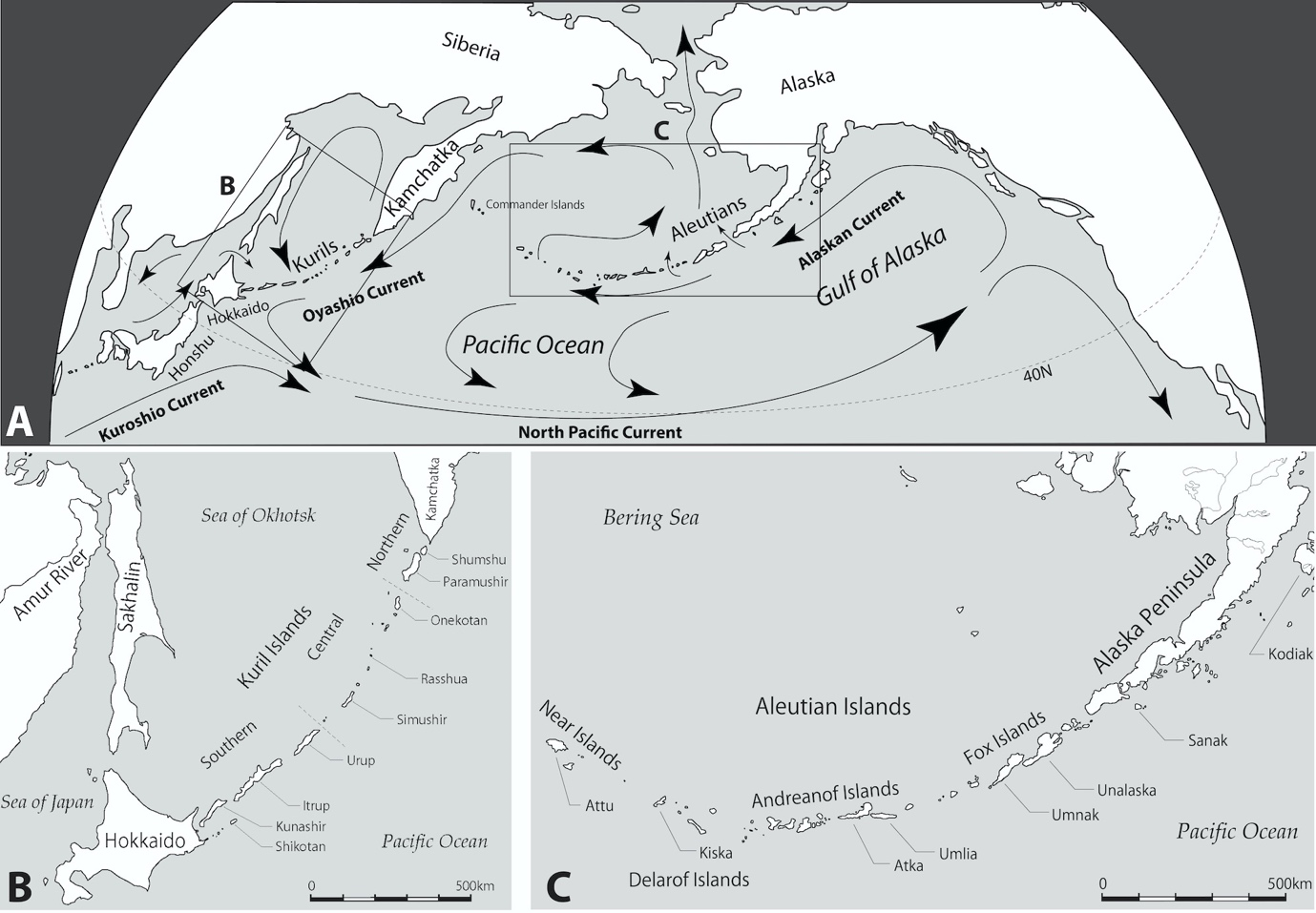
The Kuril and Aleutian Islands span more than 3000 km of the North Pacic Rim—tenuous perches of
tectonically active and windswept rocks in otherwise vast expanses of subarctic ocean and sea. Humans
expanded into and across these island chains incrementally in the early and middle Holocene, hunting,
shing, and gathering predominantly marine resources, including seabirds. While each archipelago has a
unique history, their comparison through the lenses of geography, ecology, demography, and social
interaction offers insight into the human ecodynamics and historical ecologies affecting population
vulnerability and resilience in these islands. Despite broadly similar physical and ecological parameters,
ancestral Unangan people in the Aleutians have been considerably more persistent compared to settlers of
the Kurils. These differences likely emerged from a combination of variances in ecological productivity,
the greater dependence of Kuril residents on external social networks, and changes in social competition
during the late Holocene. Lead Author: Katsunori Takase (Hokkaido University)
Human ecodynamics in the Kuril Archipelago and Aleutians
Katsunori Takase & Ben Fitzhugh. “Human ecodynamics in the Kuril Archipelago and Aleutians.” Oxford Handbook on Island and Coastal Archaeology, S. Fitzpatrick & J. Erlandson. Oxford: Oxford U. Press. https://doi.org/10.1093/oxfordhb/9780197607770.013.22