Spring 2026 Newsletter
Department of Anthropology | University of Washington
Accolades & Awards
Accolades
Three of our 2026 graduates received distinguished University of Washington awards:
Dr. Amanda Kunkle (PhD, Biological Anthropology) received the 2026 College of Arts & Sciences Graduate Medal in Social Sciences. Her dissertation examined ADHD as a product of evolutionary mismatch, using mixed methods to identify possible adaptive benefits of ADHD-associated traits.
Sara Desai (BA, Anthropology / Environmental Studies) and Mathilda Myerhoff (BA, Anthropology / Environmental Studies) were named to the Husky 100, an annual recognition of 100 student leaders who have made outstanding contributions to UW and their communities.
Emeritus Professor Eric Alden Smith was honored with a Lifetime Achievement Award from the Evolutionary Anthropology Society at the Annual Human Biology Association Meeting in Denver, CO on March 20, 2026.
Grants & Fellowship
Isabella Araiza (PhD student, Biological Anthropology) received funding from the Newell-Morris Primate Fieldwork Fund to support her dissertation research investigating forearm adaptations to nonhuman primate climbing behaviors.
Abigail Harward (PhD student, Biological Anthropology) was awarded a 2026-27 CSDE T32 Data Science and Demography Training Grant
Departmental Dissertation Completion Awards were granted to Elizabeth Wessells (Archaeology) and Yarinid Vélez Hernández (Biological Anthropology).
Melanie Martin (Associate Professor, Biological Anthropology) received a 2026 UW Research Royalty Fund Award for her proposal “A Bioethnographic Study of Type 2 Diabetes Experiences and CGM Feasibility in a Rural Indigenous Community.”
New Research & Curriculum Spotlights
Undergraduates Lucy Katzman-Tranah and Amanda Schmidt completed the sorting, inventory, and repatriation of 44 boxes of lithic artifacts from the 7,500–6,000-year-old Tanginak Spring Site to the Alutiiq Museum in Kodiak, a collection that had been at UW since a field school in 1998–2003. Both students have now graduated and are exceptionally well prepared to pursue future careers in collections-based research and management.
Archaeology Honors Student Raquel Matthews was featured in the UW College of Arts & Sciences Perspectives series for her work unearthing clues about past lives.
Professor Rachel Chapman is co-facilitating the Good Black Birth Initiative in Seattle — a 15-community organization project convened by Byrd Barr Place — completing an 18-month research collaboration charting a roadmap for perinatal equity and birth justice in Washington. This work was recently featured in the Seattle Medium.
Four undergraduates working with Dr. Marieke van Eijk published independent research on medical debt in Critical Care (Medical Anthropology Quarterly), arguing that hospitals systematically fail to help patients access financial aid. Read the essay and their accompanying medical debt brochure.
Dr. van Eijk’s ANTH 479 (Healthcare in U.S. Prisons and Jails) students produced The Chronicle of Carceral Care, an Ezine challenging dominant narratives about incarceration and health through essays, op-eds, poems, and art.
Dr. Melanie Martin and nine undergraduates completed a year-long community-based participatory research project with a local Title I elementary school. The project will continue next year through a formal partnership with the UW Center for Community Engaged Learning & Education.
Dr. Jamaal Muwwakkil was interviewed by NBC News about the origins of Gen Z’s vocabulary in African American language and culture.
Dr. Paulina Przystupa invited local archaeological professionals to come to share their experiences with students in her winter Archaeology course.
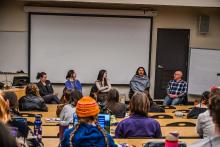
Dr. Paula Saravia contributed a chapter, “Translating the Invisible: Intercultural Health Facilitators in Indigenous Chile,” to the new volume Language and Health in Action (Oxford University Press) — a resource designed for undergraduate teaching at the intersection of linguistic and medical anthropology.
Recap of Winter and Spring Events
UW Anthropology hosted the 9th Northwest Evolution, Ecology, and Human Behavior (NWEEHB) Symposium at the UW Pack Forest Conference Center (Feb 27–Mar 1, 2026), drawing participants from seven PNW universities. UW student attendee costs were fully funded by UW Anthropology donor funds. Read the full recap.
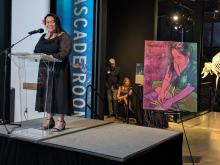
Ronalei Gasetoto (PhD student, Sociocultural Anthropology) played a key role in the Burke Museum’s Spring Gala, speaking about the importance of building spaces of belonging in museums — a focus of her dissertation research and her leadership of the Research Family program at the Burke.
UW Anthropology was well represented at the Annual Joint Meetings of the Human Biology Association (HBA) and American Association of Biological Anthropology in Denver, CO in March, with AABA presentations from undergraduates Addie Lomax and Izak Veals; graduate students Isabella Araiza, Abigail Harward, Carly Salazar, and Edward Stuart; Postdoctoral Scholar Cristina Gildee; and faculty Dan Eisenberg, Cristine Harper, Patricia Kramer, and Tiffany Pan; and HBA presentations from graduate student Amanda Kunkle and faculty Melanie Martin.
In April, the Anthropology Alumni Career Panel brought together alumni from diverse professional backgrounds to share their paths beyond graduate school.
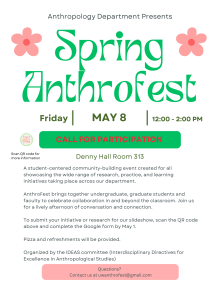
On May 8, the IDEAS Committee hosted the Spring 2026 AnthroFest, a student-centered showcase highlighting the breadth of research and collaborative work across the department.
Anthropology students turned out in force at the 2026 UW Undergraduate Research Symposium, showcasing the breadth and rigor of undergraduate research in our department.
Jon Chu and Sumaya Mohamed presented their doctoral proposals at the inaugural Alter/Native Anthropology Research Colloquium on June 9, 2026.
On Sunday June 14, we celebrated the Department of Anthropology Class of 2026 at our Graduation Celebration at Kane Hall Auditorium, honoring the achievements of 258 undergraduate and graduate students.
Wienker Awards for Best Undergraduate Essays
These annual awards, made possible by a generous contribution from alumnus Curtis Wienker (UW BA; PhD, University of Arizona, 1975), recognize excellence in undergraduate writing and original class projects.
Best Essay in Sociocultural Anthropology: Alfredo Loera III — What EMS Has Taught Me: Something Will Break (Nominated by Dr. Marieke van Eijk)
Best Essay in Biological Anthropology (awarded jointly): Leo Sun and Caleb DeBoer — Sleep, Leisure Activities, and Stress (Nominated by Dr. Melanie Martin)
Best Essay in Archaeology (awarded jointly): Melissa Fuentes and Zoe Bradley-Hart — Survival of the Youngest: Childhood, Foraging, and Culture (Nominated by Dr. Paulina Przystupa)
Departmental Honors Award (Best Undergraduate Honors Thesis): Lucy Katzman-Tranah — Metrics of Mobility: Residential Structures in the Archaeology of Kodiak Island. Her thesis presented a compelling analysis of changes in residential durability across 7,000 years of Kodiak’s cultural history, using post hole diameter to shed new light on longstanding debates about early dwelling permanence and the evolution of earth house construction over time.
Service Recognition
Professor Patricia Kramer was recognized by the UW Graduate School Dean and College of Arts & Sciences Division Dean for her exceptional service on the UW PhD Taskforce Steering Committee. Patricia’s leadership in working group discussions and her thoughtful engagement with complex questions in doctoral education were credited as instrumental to the taskforce’s recommendations to shape the future of PhD programs across the university.
Professors Rachel Chapman and James Pfeiffer are faculty advisers for a new UW chapter of Washington Physicians for Social Responsibility (WPSR), bringing together students, staff, and faculty interested in health and social justice. Contact them to be added to the listserv.
Professor Chapman has also been asked to serve on the Washington State Public Health Association (WSPHA) Diversity, Equity, Inclusion, and Belonging (DEIB) Committee, bringing her expertise in health equity and community-engaged research to statewide public health leadership.
Department News
After many years of distinguished contributions to UW Anthropology, ProfessorPeter Lape has retired. A leading figure in Island Southeast Asian and Pacific archaeology, Peter’s work shaped our understanding of human migration and cultural change across the region. We are grateful for his decades of scholarship, mentorship, and service to the department.
Dr. Radhika Govindrajan has accepted a faculty position at Columbia University. We are proud of her achievement and will miss her presence in the department.
Featured Publications
Archaeology
Communications Earth & Environment 7, 84 (d’Alpoim Guedes and colleagues) — Projected warming will exceed the long-term thermal limits of rice cultivation, with major implications for global food security
The Archaeology of the Tibetan Plateau (Cambridge University Press) (d’AlpoimGuedes and colleague)
Alaska Journal of Anthropology vol 23 (Sven Haakanson with PhD alumni HollisMiller) guest-edited this special issue on Community-Based Archaeology in Alaska, growing out of a 2023 UW workshop bringing together students, faculty, community leaders, heritage professionals, and National Park Service archaeologists. The issue addresses the promises and barriers of community-based archaeology in Alaska and offers best practice recommendations for building relationships, accountability, and measuring project success.
American Antiquity 91(2):259–281 (Ben Marwick with undergraduates Anne Marie Poole and Ailin Zhang and graduate student Setareh Shafizadeh) – Ten years of archaeology job ads reveal that technical methodological expertise offers more career stability than topical or geographic specialization.
Biological Anthropology
American Journal of Biological Anthropology 189 (2): e70212 (Christine Harper and Patricia Kramer with undergraduate student Addie Lomaxb— Examines how pregnancy may permanently alter foot structure, finding that women who have given birth have a wider angle between the big toe and the rest of the foot
American Journal of Human Biology 38(6): e70289 (Melanie Martin, Dan Eisenberg, and Tiffany Pan, with alumni PhD Delaney Glass andgraduate student Emma Anastasi) — Examines relationships among maternal Epstein–Barr virus antibodies, COVID-19 exposure, and stress in mothers up to one year postpartum
Frontiers in Digital Health 8:1634669 (graduate student Yesenia Navarro-Aguire and colleagues) — Bioethical considerations for deploying mobile mental health apps in low- and middle-income country settings, drawing on a pilot study in rural India.
Sociocultural Anthropology
“Translating the Invisible: Intercultural Health Facilitators in Indigenous Chile,” in Language and Health in Action (Paula Saravia and colleague). Explores the challenges faced by Mapuche intercultural health facilitators in rural Chile.
Frontiers in Psychology 17:1845262 (Jing Xu and colleagues) — Demonstrates both cross-cultural regularities and meaningful differences in parental beliefs about children’s social learning across four cultures (Chinese American, Bayaka, Bandongo, and Scots)
Infant and Child Development 35(3): e70114 (Jing Xu and colleagues)— Practical recommendations for naturalistic observation of children and adolescents across diverse cultural settings, based on an international collaboration.
Support Anthropology at UW
Our students and faculty are doing remarkable work — advancing knowledge, supporting communities, and training the next generation of scholars. Your support makes it possible. From student research funding to conference participation, donor contributions directly enable the work you’ve read about in this newsletter.