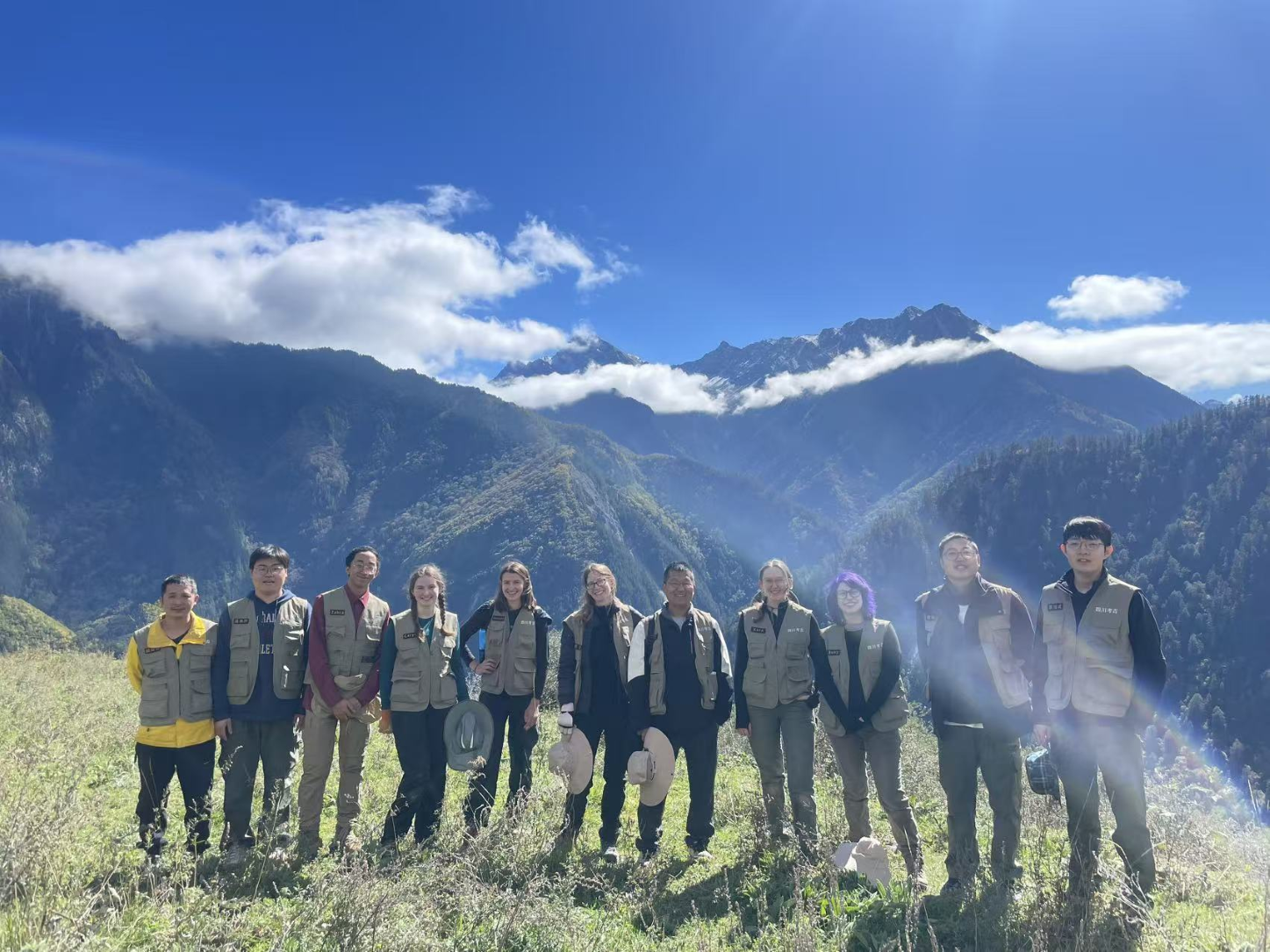
Each year, University of Washington faculty and students participate in research that deepens our understanding of humanity’s past while strengthening global academic partnerships.
This fall, a team from University of Washington’s Department of Anthropology traveled to one of the most biologically and culturally rich regions on the planet: the Jiuzhaigou National Nature Reserve (JNNR), 九寨沟 (Tibetan: gzi-rtsa sde-dgu་), located in western Sichuan.
Jiuzhaigou is not only one of China’s most celebrated natural landscapes—welcoming more than 5 million visitors annually—but also a place where people have shaped and lived with the environment for millennia. Archaeological research suggests a far longer and more complex relationship between people and this landscape than modern policy assumes.
We are excited to share that Dr. d’Alpoim Guedes, Associate Professor of Anthropology, led five UW students—Kara Johnson, Rony Guzman, Carys Dimmerer-King, Zahra Henken, and Charlotte Houston—on the latest phase of the International Collaborative Archaeological Project in Jiuzhaigou. This partnership includes the Sichuan Provincial Institute of Archaeology, Sichuan University, the University of Washington, JNNR staff, and the communities of Heye and Zharu. Together, the team is investigating how long people have occupied the terraces throughout the reserve and how past communities modified their environment. It is currently the only international collaborative archaeological project operating in China.
Through recent excavations, researchers have found compelling evidence that the ancestors of Jiuzhaigou’s present-day inhabitants built and lived on these terraces for more than 5,500 years. These discoveries are reshaping our understanding of the region’s cultural history and highlighting the deep, enduring relationship between human communities and this iconic landscape.
While in the field, University of Washington Department of Anthropology students are gaining hands-on training in archaeological methods. Their work includes learning Chinese-style excavation techniques, piloting drones, using high-precision GPS (RTK) to produce 3D maps of excavation units, and managing a full archaeological database. Students also visited several of China’s leading archaeological site museums on their journey to the field site, expanding their understanding of the region’s heritage.
Projects like this reflect UW Anthropology’s longstanding commitment to collaborative, ethically grounded research that connects students with global communities and the deep history of the places they study.